
VAT compensation is calculated from the costs in the accounts. Expenses that are never submitted don't count. Here's how expenses, cost control and compensation are connected.
The team manager spends NOK 340 on petrol for the away match. The receipt stays in a jacket pocket over the weekend, then in the glovebox, and then it is never submitted.
The club saved NOK 340. That's why nobody does anything about it.
But the unsubmitted receipt isn't where the money disappears. It's a warning sign of something else: that the team has finances that bypass the accounts. And what bypasses the accounts costs the club 8 per cent.
Who actually paid?
Someone covered the NOK 340. It was the team manager. She doesn't get it back, and says nothing, because it feels petty to make a fuss about petrol.
That's not an accounting problem. It's a recruitment problem — people don't quit over one petrol bill, but over the sum of many small things nobody dealt with. The accounting problem sits right next to it, and it is bigger.
Where the money actually is: the team fund
Most teams have a fund. It's filled by volunteer work (dugnad), raffle sales, kiosk sales and personal contributions. And it's emptied again: the bus to the away match, food at the tournament, referee bills, kits, social events.
The money in that fund belongs to the club. That's not an interpretation. NIF's accounting and auditing regulations require the bank account to be in the club's name and operated jointly by two people, and all groups and teams to be shown in the annual accounts. Most club handbooks say the same: withdrawals only against a voucher, everything into the overall accounts.
In practice, many team funds still live alongside the accounts. Not because anyone is trying to hide anything — but because there was never an easy way to do it properly. And then the costly thing happens:
The team spends NOK 2,400 on kiosk goods before the cup. The money came from volunteer work (dugnad), it went straight back out on purchases, and neither the income nor the cost ended up in the club's accounts.
That's NOK 2,400 of the club's operating costs that don't exist anywhere.
How VAT compensation is calculated
In the simplified model, the basis for the application is the organisation's total operating costs — taken from audited and approved accounts, with some deductions. The compensation is 8 per cent of the basis up to NOK 7 million, and 6 per cent above that. The minimum threshold for receiving anything at all is a basis of NOK 100,000.
Read the terms at Lotteri- og stiftelsestilsynet (the Norwegian Gaming and Foundation Authority).
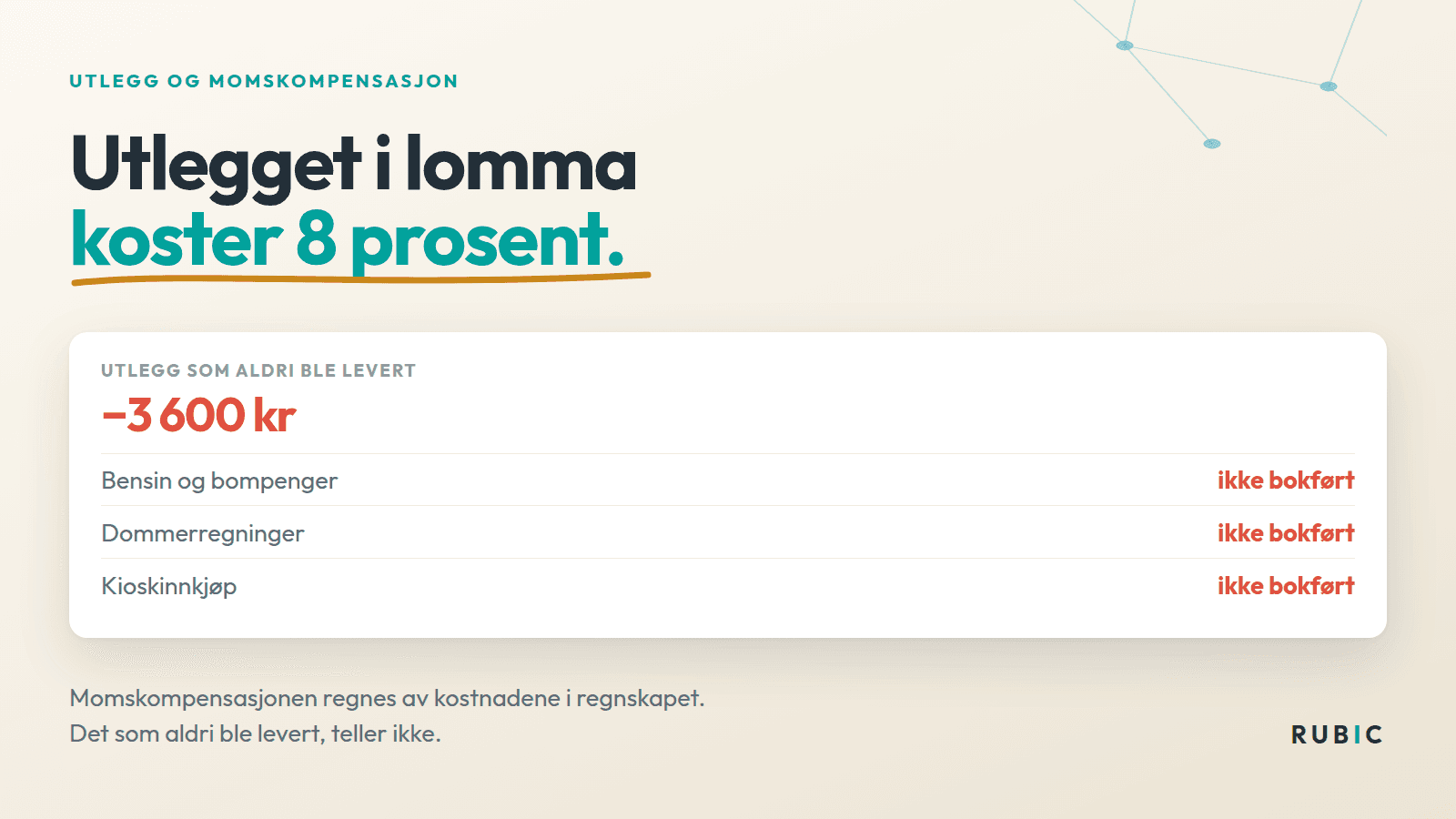
The consequence is simple, and worth saying out loud: a cost that never makes it into the accounts is not included in the basis. And then the club doesn't get the 8 per cent of it either.
So the NOK 2,400 for the kiosk isn't just NOK 2,400 that vanished from view. It's also NOK 192 the club would have got back, if the cost had been in the accounts.
Why the costs disappear
This is why expenses deserve more attention than they get. They are treated as an irritation — someone needs paying back, someone has to enter it — when in reality they are one of the biggest sources of costs that disappear from the accounts.
And they disappear for entirely undramatic reasons:
- The amount is too small to bother submitting.
- The receipt is gone by the time the team manager finally has time.
- She doesn't know who to send it to, or in what format.
- She sent it, but it got stuck in an email thread with a treasurer who had too much to do.
None of these are attitude problems. All four are threshold problems. The higher the threshold for submitting an expense, the larger the share of the club's actual costs that ends up outside the accounts.
Flip the calculation: what you actually get back
It's easy to read this as yet another warning. It's actually the opposite, and worth saying plainly:
Every NOK 100,000 that makes it into the accounts means NOK 8,000 back to the club.
Not as an application you have to win in competition with others. The scheme has a fixed budget, but the budget has held: for 2025, Lotteri- og stiftelsestilsynet paid out NOK 2.87 billion — the entire approved application amount, for the second year running. What the club applied for, the club received. What the club didn't apply for, nobody received.
You don't need to be big. The minimum threshold is a basis of NOK 100,000. A club with 150 members passes it without trying — if the costs are actually in the accounts.
You don't need to do anything new. These are costs the club already has. The volunteer work (dugnad) has been done, the kiosk stock has been bought, the bus has been paid for. The only thing missing is for the money to pass through the club's account and be entered in the books.
The money is unrestricted. VAT compensation isn't earmarked. It goes straight into operations — for equipment, for the coach, for keeping the membership fee down.
And because the basis is taken from last year's audited accounts, the work you do this autumn only takes effect next year. That is also the whole point: what you tidy up now pays for itself next autumn.
The calculation
Work out your own. Two figures are enough: how much the teams handle over a year — income from volunteer work (dugnad), personal contributions, kiosk, cup fees, expenses — and what share of the costs never makes it into the club's accounts. Ask three team managers. The answer tends to surprise.
An example: a club with 12 teams, where each team turns over NOK 15,000 during the season, has NOK 180,000 in team finances. If a quarter of the costs are never recorded, NOK 45,000 of the club's operating costs are outside the basis. That's NOK 3,600 in lost compensation — every year, without anyone receiving an invoice or a reminder that tells them so.
Replace the figures with your own. The point is the mechanism, not the example.
Lower the threshold, and the costs come in
In Rubic, the team manager registers the expense on the spot: a photo of the receipt in the app, the amount, what it's for. When the expense is approved, it is recorded as a supplier invoice in the accounting system — and where the system supports it, the payout can happen automatically.
The integration runs through iizy and supports Tripletex, PowerOffice Go and Finago.
The difference isn't that the expense is recorded more accurately. The difference is that it gets recorded at all, because it takes twenty seconds in the car park instead of an evening at the kitchen table.
The expense is the way in. The team fund is the rest.
And then you get control of costs along the way
Team account shows the balance and transactions for a single team, based on the figures in the accounts — even if all teams share the same physical bank account. Each transaction carries the date, amount, type, person, description, project and section.
It's the last two that do the work. Section is football or handball. Project is Boys U10 or Boys U12. Costs thus become visible at the level where they actually arise, while the season is under way.
- The team manager sees what the team has spent and what is left — without asking anyone.
- The club sees which teams are heading for an overspend in October, not in February.
- The treasurer no longer has to allocate costs to teams after the fact. It's already done.
Cost control in a sports club is rarely about cutting. It's about knowing what is being spent while there is still time to do something about it.
All the way, if you want
Rubic Regnskap takes care of the rest: the sports chart of accounts set up from the start, ongoing bookkeeping through Catacloud, and year-end accounts ready for the auditor and the annual general meeting. We handle VAT compensation together with the club — and then the basis has been built throughout the year, not reconstructed in August.
ECIT stands behind it, with 3,500 colleagues in 11 countries.
How much of the club's costs are outside the accounts today?
Book a free demo — 30 minutes, and we'll work it out together.
Rubic is part of ECIT.