
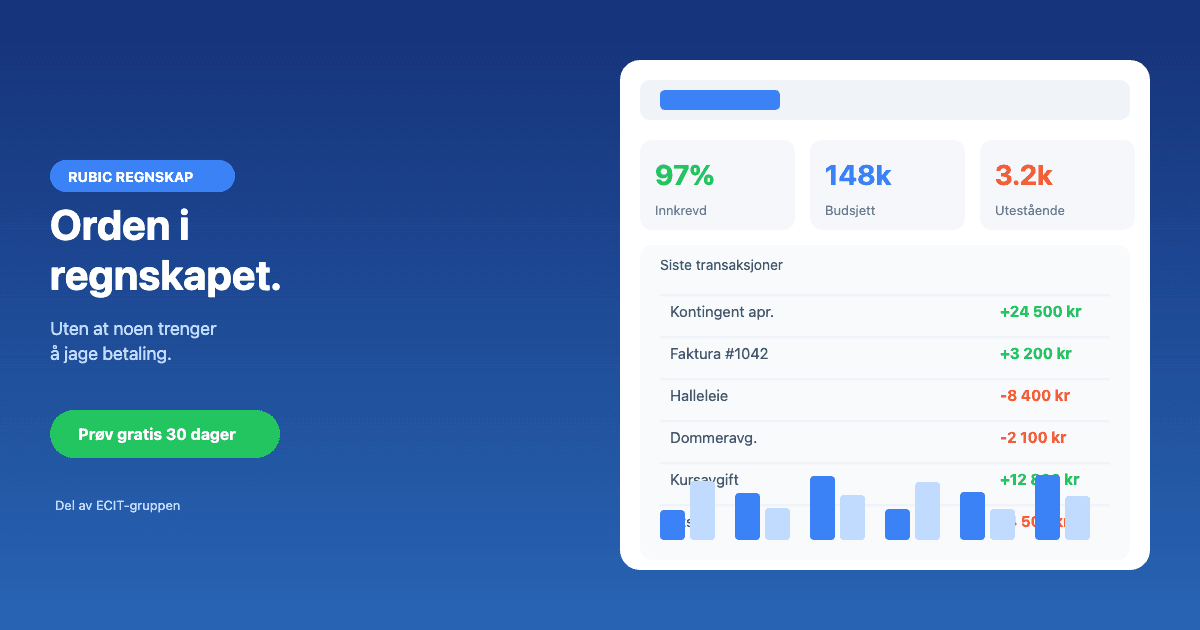
You said yes to joining the board because you are passionate about your club, association or organisation. Not because you dreamed of staying up until midnight with financial admin, VAT compensation and accounting reports you barely understand.
Yet this is exactly where many end up. Norwegian volunteering rests on dedicated enthusiasts who spend hours – hundreds of hours – on financial tasks they never asked for. The result? Treasurers who burn out, board members who hold back, and organisations that risk costly mistakes.
It doesn't have to be this way.
Why is accounting for sports clubs and associations so complicated?
Sports clubs are not like ordinary companies. Associations are not like ordinary businesses. They operate in their own ecosystem of laws, regulations, special schemes and reporting requirements that even experienced accountants can struggle to keep track of.
Here are some of the challenges that make accounting for sports clubs and associations particularly demanding:
NIF's accounting and auditing provisions
All sports clubs affiliated with Norges Idrettsforbund are required to keep accounts and must follow NIF's own provisions. This means you don't just deal with bokføringsloven (the Norwegian Bookkeeping Act) – you also need to know sport's own set of rules. Sports clubs with a turnover of more than NOK 5 million are also required to follow regnskapsloven (the Norwegian Accounting Act) and have a state-authorised or registered auditor.
The sports chart of accounts and special requirements
There is a standardised chart of accounts for sports clubs that ensures membership fees, training fees, volunteer work (dugnad) and grants are recorded correctly. Incorrect account coding can mean that applications for VAT compensation or other grants are wrong – or, in the worst case, rejected.
VAT compensation
The VAT compensation scheme is an important source of income for voluntary organisations, but the application requires the accounts to be correctly kept and documented. Many organisations miss out on large sums because their accounts are not up to the required standard. Read our complete guide to VAT compensation for sports clubs.
Multiple income streams and complex finances
A typical sports club handles membership fees, training fees, income from volunteer work (dugnad), sponsorship agreements, barter agreements, referee fees, travel expense claims, expenses, kiosk sales, ticket sales, public grants – and perhaps facility rental as well. Each type of income has its own rules for recording and reporting.
Volunteers in the finance role
Perhaps the biggest challenge: it is rarely finance professionals who hold the responsibility. It is parents, coaches and dedicated enthusiasts – volunteers giving up their free time. When the treasurer changes every other year, the training starts all over again. Continuity in financial management becomes almost impossible.
The problem with the “ordinary” accountant
Many sports clubs and associations choose to bring in an external accountant. It's a sensible idea, but as many discover: an ordinary accountant rarely knows the special rules that apply to sport.
The result? You end up training the accountant – instead of the accountant giving you qualified advice. Every year it's “here we go again”: another review of the rules, more explanations of how membership fees and training fees should be treated, more discussions about VAT compensation.
There is a real competence gap in the market. Ordinary accounting firms are skilled at handling hair salons and property companies, but often lack the specialist expertise that associations and sports clubs need.
What associations need – and how it differs from sports clubs
Although many of the challenges are shared, associations have their own needs that differ from those of sports clubs. A nationwide association with a central administration, county branches and local branches will typically need:
- Consolidated accounts across organisational levels, with the option to view each level separately
- Project accounting linked to applications, grants and specific initiatives
- Membership fee management with different rates for different membership categories
- Statement of activities that meets the requirements of Frivillighetsregisteret
- Reporting to donors and supervisory authorities that builds trust and demonstrates accountability
For sports clubs and associations alike, the same basic principle applies: the accounts must be correct, up to date and give management a real basis for decision-making. But the path there differs, and the solution must be tailored.
Rubic Regnskap: Developed for exactly these needs
We at Rubic have worked with sports clubs, associations and organisations for many years. We understand the challenges because we live in this landscape every day – from children's sport to elite sport, from local residents' associations to national federations.
With Rubic Regnskap, we have built a solution tailored to the unique needs of voluntary organisations. And we have done it in partnership with ECIT, one of the Nordic region's leading companies in accounting and financial services.
How it works in practice
Automated bookkeeping. Membership fees, training fees and other payments managed in Rubic are posted automatically in the accounting system. You avoid manual double entry, and the risk of errors is drastically reduced.
A dedicated contact at ECIT. You get a dedicated, state-authorised accountant who knows the financial landscape of sport and associations. You don't have to train anyone – you are the one who gets the advice.
Integrated with the rest of Rubic. Rubic Regnskap is not a stand-alone accounting program. It is an integrated part of the Rubic platform, which means that data from the member register, the payment system, registrations and activities flows seamlessly into the accounts. One system, one source of truth.
Simpler referee payments. For sports clubs using Rubic's referee module, the whole process is handled digitally: the referee submits a claim in the app with one click, the referee coordinator approves it, and the voucher is transferred directly to the accounts. No manual entries, no paper receipts.
Expense handling in the app. Coaches, volunteers and board members register expenses directly in the Rubic Connect app. Approval, bookkeeping and payment happen seamlessly.
Predictable price. You pay a fixed price based on the size of your organisation – not per voucher or per hour. You always know what your accounting costs, with no surprise invoices.
ECIT as accounting partner
ECIT is not an ordinary accounting firm. With a presence across the Nordic region and specialist expertise in accounting for sports clubs and associations, they bring a depth of experience that is hard to match.
Through the partnership with ECIT, Rubic customers get access to accounting experts who know everything from day-to-day bookkeeping to strategic advice on VAT compensation, sponsorship agreements and facility investments. They know NIF's regulations, they know what the VAT compensation application should look like, and they understand what sets a multi-sport club's accounts apart from those of a local health association.
In 2023, Rubic became part of the ECIT family. This means the accounting service is not just a partnership – it is an integrated part of our strategy to give Norwegian organisations the very best financial support.
From chaos to control: What an integrated solution actually means
Let's talk about what happens when you have a system where everything is connected – and compare it with the reality many organisations experience today.
Without an integrated system
The treasurer keeps the accounts in a separate accounting program or a spreadsheet. The member register sits in a membership system or an Excel sheet. Payments come in via Vipps, online banking and AvtaleGiro. Expenses are sent by email, Messenger or Snapchat. Referee claims are written on paper.
The result: information lives in 3–6 different systems that don't talk to each other. That means manual data transfer, which means duplicated work, which means errors, which means worry, which means stress.
With Rubic Regnskap
Everything starts in Rubic. The member joins, the membership fee is invoiced and the payment is posted. The coach registers an expense in the app, it is approved and posted. The referee sends a claim with one click, and it is posted. Unpaid membership fees are followed up with automatic reminders. The accounts are always up to date, always correct, always available.
And behind the scenes sits a dedicated accountant from ECIT who quality-assures the work, reports to public authorities, handles VAT settlements and is available for questions and advice.
Who is Rubic Regnskap for?
Sports clubs – from children's sport to elite sport
Whether you run a small football club with 50 members or a multi-sport club with thousands of active participants, Rubic Regnskap is adapted to your reality. Multi-sport clubs with several sections get accounts that handle the complexity of different sports, different income sources and many volunteers – without losing the overview.
Associations and organisations
Nationwide organisations with several levels, a central administration and a need for consolidated reporting. Local associations that need a simple, professional solution without hiring an accountant. Federations that must report to donors, public authorities and their own members.
Event organisers
Organisations that run large events – festivals, sporting events, conferences – and need project accounting, volunteer coordination and financial management for individual events. Customers such as Norway Cup, Ski-VM and Holmenkollen Skifestival already use Rubic.
Checklist: Signs that your organisation needs a better accounting solution
Do you recognise any of these situations?
- The treasurer spends more than 5 hours a week on financial tasks – time that should have gone to activities
- You use more than two systems to manage finances and administration
- Vouchers and receipts come in via email, Messenger, text message and paper
- The VAT compensation application is an annual source of stress
- New board members spend weeks getting to grips with the finances
- You are unsure whether the accounts comply with NIF's provisions or current legislation
- Your accountant constantly needs training in your organisation's special rules
- The annual accounts are never ready for the annual general meeting without panic
Do you recognise three or more? Then it's probably time to consider Rubic Regnskap.
Frequently asked questions about accounting for sports clubs and associations
Do sports clubs have to keep accounts?
Yes. All sports clubs affiliated with NIF are required to keep accounts under NIF's own provisions. Sports clubs with more than 600 vouchers a year must use an electronic accounting program. Clubs with a turnover of more than NOK 5 million must also follow regnskapsloven (the Norwegian Accounting Act) and have an auditor.
What is the sports chart of accounts?
The sports chart of accounts is a standardised chart of accounts developed specifically for sports clubs. It ensures that typical income and costs in a sports club – such as membership fees, training fees, income from volunteer work (dugnad) and grants – are recorded in the correct accounts. Using the right chart of accounts is important for correct reporting and for VAT compensation applications.
What is VAT compensation for voluntary organisations?
The VAT compensation scheme allows voluntary organisations to apply for compensation for the VAT they have paid on purchases of goods and services. For many sports clubs and associations, this amounts to significant sums. The application requires the accounts to be correctly kept and the organisation to be registered in Frivillighetsregisteret.
How much does Rubic Regnskap cost?
The price is based on the size of your organisation (number of members) and its complexity (single sport vs. multi-sport, association with few or many levels). You pay a fixed, predictable price – no surprises. Contact us for a no-obligation quote tailored to your organisation.
Can we keep the accounting system we use today?
Rubic Regnskap integrates with several of the most widely used accounting systems in Norway, and we are continuously working to expand the integrations. Through the partnership with ECIT, we are system-independent and can adapt the solution to your needs.
Is Rubic Regnskap suitable for associations that are not sports clubs?
Absolutely. Rubic Regnskap is developed for all types of voluntary organisations – sports clubs, cultural associations, health associations, interest organisations, student associations and national federations. The underlying accounting needs are largely shared, and we tailor the solution to each organisation's requirements.
Ready to take control of your finances?
More than 500 Norwegian sports clubs and associations already use Rubic every day. With Rubic Regnskap, you take the final step towards a fully integrated everyday – where administration, payments, communication and finances are seamlessly connected.
Stop spending volunteering's most valuable resource – time – on tasks that can be automated.
See for yourself how Rubic Regnskap can simplify financial management in your organisation. We'll show you exactly how it works for your type of organisation – whether you run a sports club, an association or an event.
Tell us your type of organisation, number of members and your needs – and you'll quickly receive a tailored quote.
Read more
Want to dive deeper into the topics we've covered in this guide? Here are our detailed articles:
- VAT compensation for sports clubs: Everything you need to know to get the money you are entitled to
- The sports chart of accounts explained: How to use the chart of accounts for sports clubs and associations correctly in your club
- The accounting obligation for sports clubs: What does NIF require – and how do you meet the requirements?